
The only perfect-score champion: Professor Fang Bin's team excels at the ICRA 2026 Embodied AI Challenge
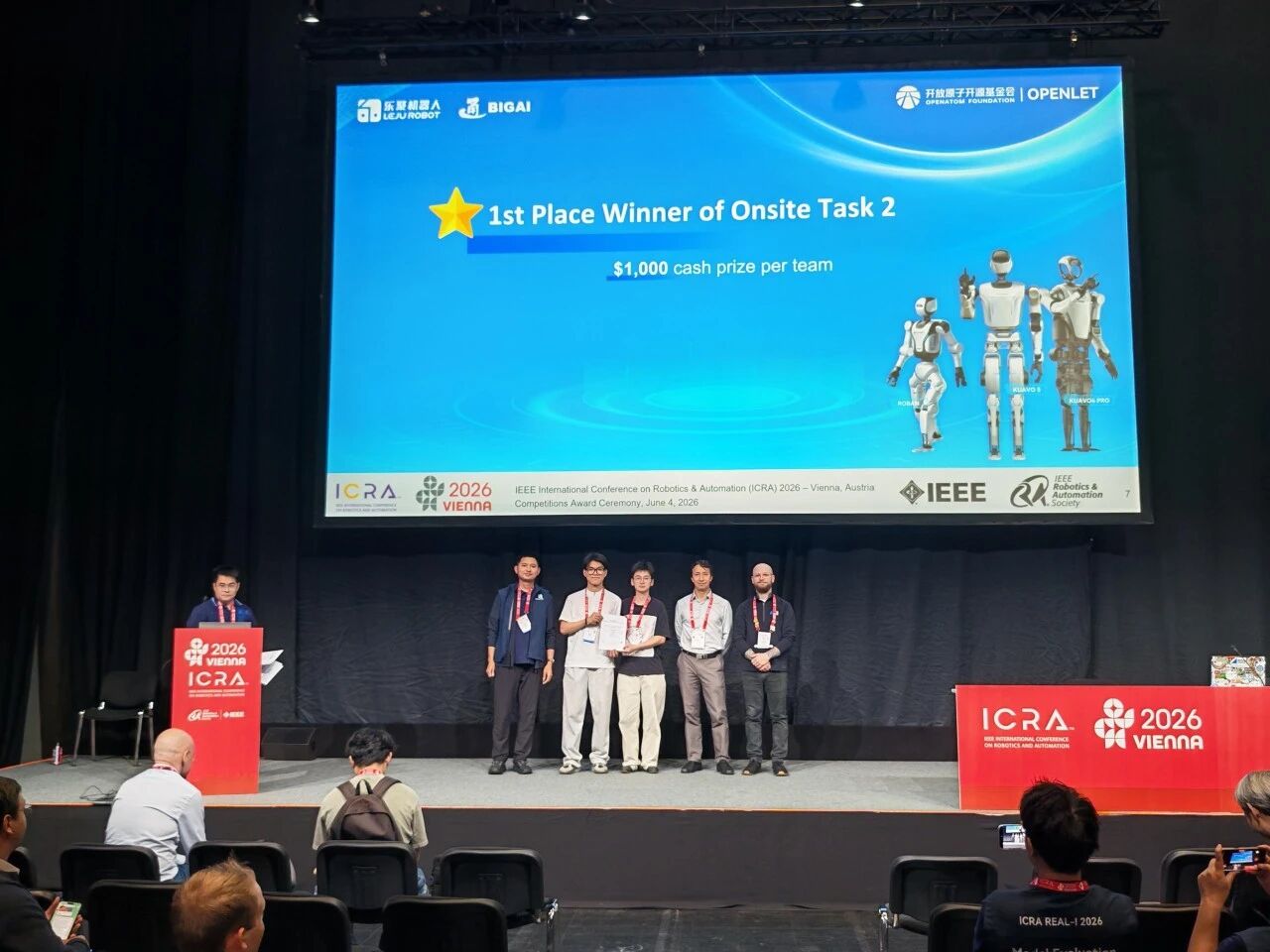
The 2026 IEEE International Conference on Robotics and Automation (ICRA 2026) was recently held in Vienna. As the flagship robotics conference organised by the IEEE Robotics & Automation Society, ICRA brings together leading researchers, engineers and industry representatives from around the world each year. According to the ICRA 2026 website, this year's conference received a record 5,088 paper submissions and hosted nine official robotics competitions covering areas including grasping and manipulation, dual-arm collaboration, robotic surgery and embodied world models.
Among these nine competitions, REAL-I (The 1st Real-world Embodied AI Learning Challenge) attracted 48 teams from China and overseas. It was the largest on-site physical robot competition at this year's ICRA and one of the most closely aligned with industrial applications. Unlike conventional simulation benchmarks or isolated manipulation contests, REAL-I was designed around the real world: physical robot platforms, real industrial tasks, common evaluation tools, and a complete validation process spanning simulation, remote physical robot testing and on-site challenges.
The challenge examines whether embodied AI systems can actually be deployed on physical robots and perform industrial tasks consistently despite changing environments, randomly positioned objects and limited on-site data. Rather than testing whether a model can complete a single demonstration in ideal conditions, REAL-I functions as a practical stress test for industrial deployment.
In this year's REAL-I Challenge, the team led by Professor Fang Bin, SynDexy's Chief Scientist and a professor at Beijing University of Posts and Telecommunications, earned full marks in the humanoid robot industrial loading and unloading event. It was the only team to achieve a perfect score in an on-site physical robot manipulation task. The team also won bronze in the overall competition spanning simulation, remote physical robot testing and the on-site challenge.
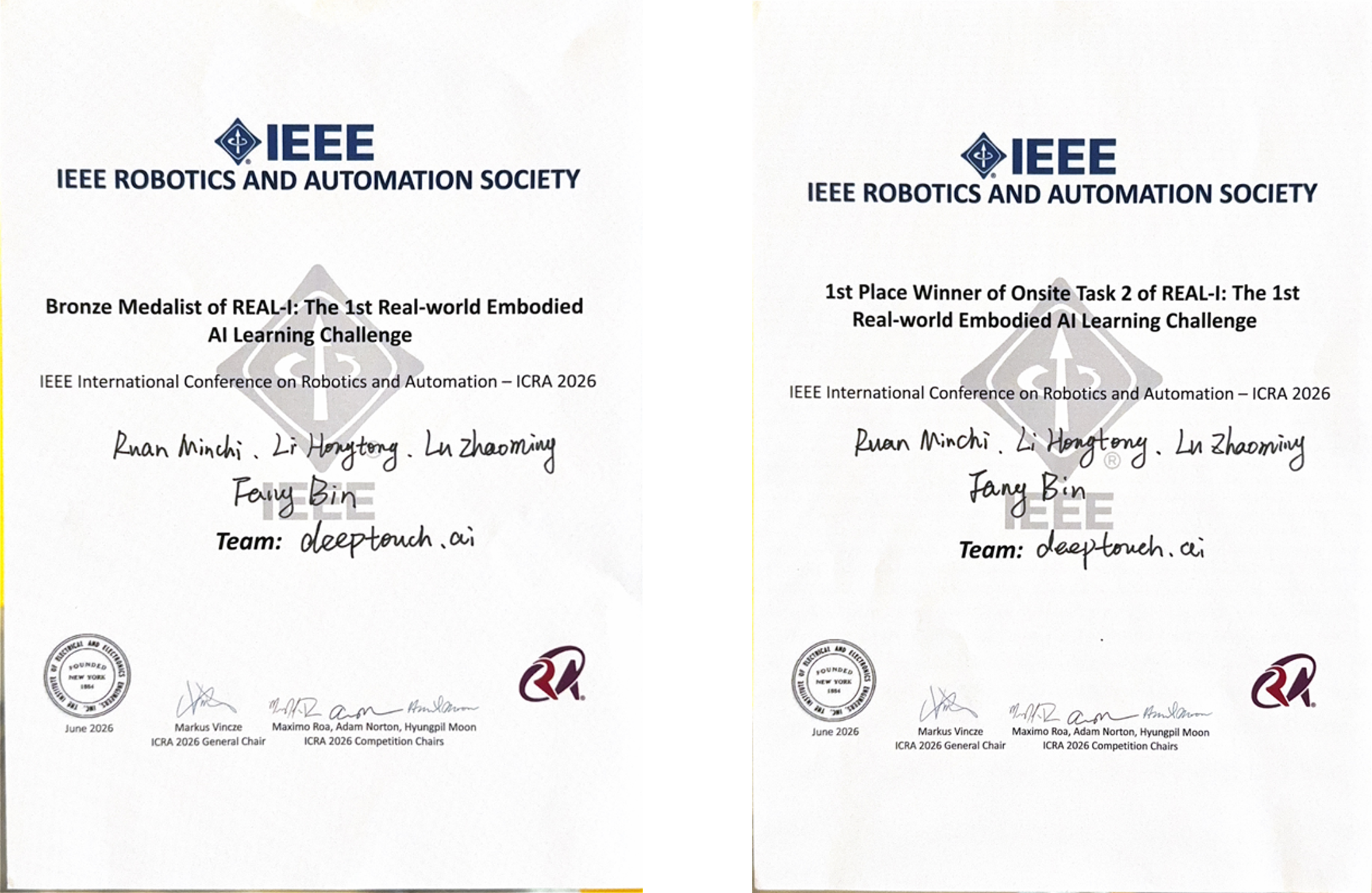
The result matters not only because it secured a championship, but because it demonstrated the team's combined capabilities in physical robot manipulation, end-to-end model deployment and stable execution of industrial tasks.
Using real industrial tasks to test embodied models
A defining feature of REAL-I is that it puts embodied AI models directly into real industrial tasks.
The on-site challenge covered three typical industrial scenarios: reorienting metal components, picking and placing consumer goods bottles for loading and unloading, and scanning and sorting parcels. These tasks reflect common industrial manipulation requirements and evaluate the complete loop from perception and understanding through planning to execution, rather than recognition alone.
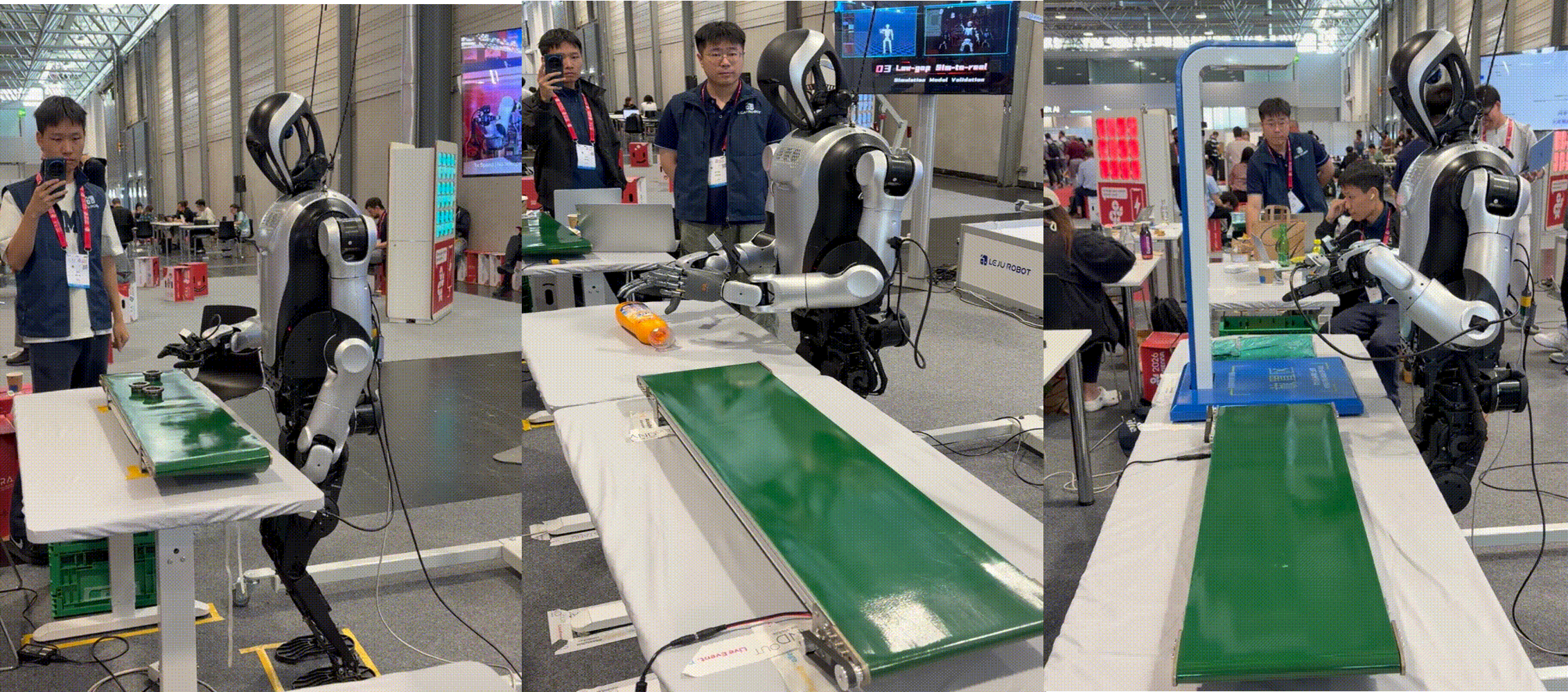
In the loading and unloading task won by Professor Fang's team, the robot had to grasp objects, transfer them between its two arms and place them stably between two conveyor belts. Object positions were randomly reset while the belts continued moving. Beyond seeing a target, the robot had to determine a grasp location, plan its motion, complete a handover and place the object accurately in a moving environment.
For a person, this might be a natural act of hand-eye coordination. For a robot, perception, decision-making, control and execution must work reliably in the same feedback loop. An unstable grasp, a failed handover or inaccurate placement could cause the task to fail.
This gives REAL-I a different significance from an ordinary robot demonstration. It tests whether an embodied model can perform repeatable operations reliably on a common platform, on common tasks and under real on-site conditions, rather than showing one ideal laboratory result. Such evaluation is closer to the concerns of real customers and production lines.
The challenge behind the only perfect score: Consistent execution
The defining aspect of this result was not simply winning, but achieving the competition's only perfect score.
REAL-I does not score a task based on an isolated successful attempt. Robots must complete three consecutive rounds after object positions have been randomly reset, with the average determining the final score. Full marks therefore represent consistent correct actions under repeated disturbances, rather than one strong run.
Professor Fang's team completed the loading and unloading task with perfect scores in all three consecutive rounds. Across all teams and tasks, it was the only team to achieve full marks in on-site physical robot manipulation.
This addresses a central challenge in commercialising embodied AI: robot demonstrations are plentiful, but reliable task execution in real environments is scarce. Industrial applications cannot accept occasional success or depend on ideal lighting, fixed object poses and unlimited tuning time. Robots must accomplish tasks with limited data, limited time and real physical uncertainty.
In this sense, a perfect REAL-I score is a stress test under realistic industrial conditions. It measures the combined performance of model generalisation, data efficiency, on-site deployment and system stability, rather than a single algorithmic metric.
From simulation to the competition floor: Testing model deployment
This year's REAL-I Challenge had three stages: simulation, remote physical robot testing and an on-site competition.
During simulation and remote physical robot testing, teams submitted trained models for organisers to deploy and evaluate. At the on-site event in Vienna, the models faced a new environment, physical robot platforms and limited supplementary data. For participants, the competition was a complete engineering test from model training to deployment on hardware, not simply an algorithm contest.
Professor Fang's team optimised its embodied manipulation models using generative manipulation policies, few-shot on-site adaptation and strategies to improve data quality. These measures improved stability in real tasks. In the on-site stage, the team had to adjust its model quickly with limited data so the robot could adapt to changes in the environment and task.
This closely resembles industrial deployment. Real factories cannot provide unlimited data or perfectly standardised environments for a robot model. Systems that can adapt on site with less data and in less time are closer to practical embodied AI.
Behind the technology: Long-term research into hands-on robot capabilities
No tactile sensors were used in this competition. All teams tested their models on a common robot platform. The result therefore reflects Professor Fang's team's combined experience in visual perception, action generation, dual-arm coordination and deployment on physical robots.
For SynDexy, however, this represents just one part of its embodied AI technology roadmap.
Vision alone is often insufficient for industrial tasks requiring greater precision and more complex contact. In precision assembly, insertion and alignment, the end effector's final millimetre of motion is frequently obscured by the workpiece or the robot itself. At that point, success depends on whether the robot can sense contact, detect small deviations and make sub-millimetre corrections.
Professor Fang's team has long researched visuotactile fusion, robot manipulation learning and precision assembly models. Its work indicates that combining vision for global positioning with touch for contact feedback, while dynamically adjusting their relative weights across task stages, can substantially improve success rates and stability in high-precision assembly.
SynDexy's focus therefore extends beyond enabling robots to see the world. It aims to give robots practical manipulation capabilities in the physical world: grasping, placing and handing objects over, as well as sensing contact, correcting deviations and completing tasks reliably in more demanding precision applications.
China's embodied AI sector is moving toward competition in real manipulation capabilities
Embodied AI has become a prominent theme across the global technology industry over the past year. As deployment advances, the competitive focus is shifting from model size to whether robots can accomplish tasks in real environments, and from impressive demonstrations to stable, reliable and repeatable systems.
The ICRA 2026 REAL-I Challenge provided an international, standardised testing ground. Professor Fang's team's only perfect-score championship in a physical robot task demonstrated publicly verifiable capabilities in end-to-end manipulation models, few-shot on-site adaptation and reliable execution of industrial tasks.
For SynDexy, the result also provides important external validation. As a company focused on general-purpose robot manipulation intelligence, it continues to develop technologies around robots' real operating capabilities. Both the industrial task execution demonstrated in this competition and its long-term research into visuotactile fusion and precision manipulation serve the same goal: moving robots from demonstrations to useful work.
From the competition floor in Vienna to real production lines, the next stage of embodied AI competition will depend on robots' ability to complete specific tasks consistently. This perfect-score championship is an important validation of the path being pursued by Professor Fang's team and SynDexy.